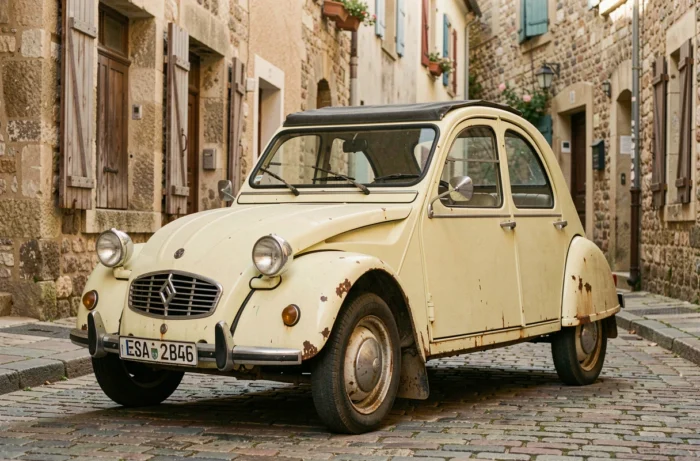
In France, calling your car “Titine” surprises no one. The word has been circulating in conversations for over a century. Its origin blends popular song, Parisian slang, and a very French relationship with everyday objects.
From first name to nickname: the track of the 1914 song
Before designating a car, Titine was a diminutive of female first names, derived from Ernestine, Christine, or Martine. This type of affectionate shortening is common in popular French at the end of the 19th century.
The word took on a national dimension with the song La Madelon, popularized during World War I. In its lyrics, one hears, “It must be admitted that this Madelon is charming, Titine too.” Titine then refers to a familiar and endearing female figure, a character evoked with tenderness.
The shift towards the automobile happened gradually. As individual cars spread in French households during the 20th century, the affectionate nickname migrated from choruses to garages. When wondering why we call a car titine, the answer lies as much in the soft sound of the word as in its connection to popular song.
Titine and the “titi parisien” speech: a slang root to trace back
The 1914 song popularized the nickname, but the linguistic soil already existed. The register of “titi parisien”, this slang from the suburbs of the 19th century, created diminutives from almost anything.
Syllabic repetition (Ti-tine, Ni-ni, Fi-fi) was a common process for creating an affectionate, mocking term, or both at once. This linguistic mechanism produced dozens of nicknames that have entered common language.
In this context, “Titine” is not a cultural accident linked to a single song. The word is part of a Parisian oral tradition where shortening and doubling the syllables of a first name marked closeness, even complicity. When this process encountered the automobile, an object of pride and daily care, the transfer was almost inevitable.
A real surname, not just a nickname
A little-known detail reinforces the word’s anchoring in Francophone culture: Titine exists as a surname in France, with a notable presence in Guadeloupe. Births bearing this surname peaked between 1901 and 1910, according to civil registry data. The word thus had an administrative existence long before it qualified a car, suggesting a deeper rooting than just the automotive register.
Automobile anthropomorphism: giving a name to your car
Naming your car is a well-documented reflex. Anthropomorphism, that is, attributing human characteristics to an object, particularly affects machines we interact with daily.
The car concentrates several factors favorable to this phenomenon:
- It has a “face” (headlights, grille) that the human brain spontaneously interprets as a face, a cognitive bias called pareidolia
- It responds to its owner’s inputs (acceleration, steering, engine sound), creating an illusion of dialogue
- It accompanies emotionally charged moments: first drives, vacations, moves, memorable breakdowns
The nickname Titine works because it reproduces the structure of a female first name. Calling your car by a first name brings it into the circle of loved ones. Other popular nicknames in France (Ma Belle, Choupette, Pépette) follow the same logic: they feminize the object and bring it closer to an affectionate relationship.
Beyond the car: Titine migrates to connected objects
In recent years, the nickname “Titine” has overflowed from the automotive field. Recently published content shows that some users employ the word, often ironically, to refer to their voice assistant or an artificial intelligence they address verbally.
This shift is not trivial. Anthropomorphism is moving towards conversational technologies, and affectionate vocabulary follows the same path. We used to talk to our car when turning the ignition key; now we talk to our connected speaker by saying a wake word.
The persistence of the nickname Titine, applied to very different objects over more than a century, illustrates a stable cultural trait: in France, the relationship with machines is expressed through intimate language. The technical register (model, brand, version) coexists with an emotional register that humanizes the object.
What car nicknames reveal about French society
The fact that the car occupies a special place in the French imagination is not just a matter of sentiment. For decades, the automobile has represented a strong social marker: access to employment, geographical autonomy, family status. Models like the 2CV or the Renault 4CV have become cultural symbols far beyond their transport function.
In this context, giving a nickname to your car acknowledges its role in daily life. Titine is not a gratuitous sweet word; it is a marker of acknowledged emotional dependence.
No specific date marks the moment when “Titine” became the default car nickname rather than just one diminutive among others. The 1914 song played an accelerating role, popular Parisian speech provided the linguistic mold, and the democratization of the automobile did the rest. Two syllables were enough for the word to stick to the machine, and it has remained there.