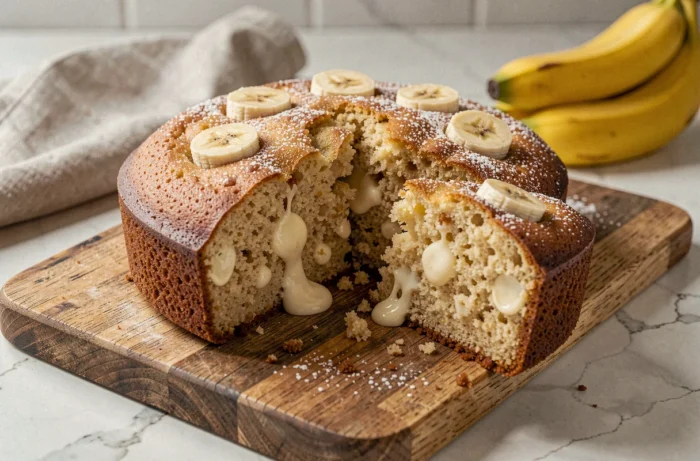
A successful banana cake relies on a precise balance between fat, sugar, and the moisture of the fruit. Adding white chocolate to this equation changes the game: its cocoa butter and sugar content alters the texture of the batter, its behavior during baking, and the final taste of the moist banana cake. Understanding these mechanisms allows for a consistently melting result, without a hit-or-miss recipe.
White chocolate and ripe banana: why this combination works in baking
White chocolate is not chocolate in the strict sense. It contains no cocoa mass, only cocoa butter, sugar, and milk powder. This composition gives it a sweet, creamy, slightly vanilla flavor profile.
Very ripe bananas, those with brown spots on the skin, develop more complex aromas than yellow bananas. Their natural sugars have concentrated, their flesh is soft and easy to mash. The riper the banana, the moister the cake will be, because the pulp releases more water and free sugars into the batter.
The combination works because the cocoa butter in white chocolate coats the flour particles during mixing. This fatty film limits gluten formation, the protein that makes cakes rubbery when the batter is overworked. The result: a more tender crumb than in a classic banana bread made solely with butter.
To delve deeper into proportions and variations, the banana white chocolate cake recipe on Chapeau Melon details each step with precise measurements.
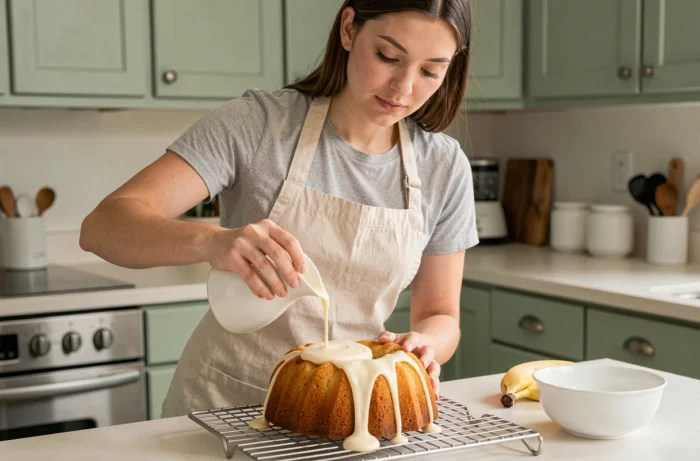
Moist banana cake: texture mistakes to avoid
Have you ever ended up with a dense, compact cake, almost wet in the center while the edges were dry? This problem rarely stems from the baking time. It almost always comes from the mixing method or the choice of ingredients.
Overworking the batter after adding flour
When incorporating flour into the liquid ingredients, gluten begins to form. A few turns of the spatula are enough to achieve a homogeneous batter. Mixing with an electric whisk at this stage toughens the crumb. You want to see a few traces of flour before adding the pieces of white chocolate.
Using low-quality white chocolate
Cheap chocolate bars often contain hydrogenated vegetable fat instead of cocoa butter. Check the ingredient list: cocoa butter should be listed first or second. Without it, the chocolate melts poorly, greases the batter instead of aerating it, and gives a flat taste.
Forgetting acidity
Bananas are a low-acid fruit. Without the addition of an acidic element (yogurt, fresh cream, or a spoonful of lemon juice), the baking soda in the baking powder does not react completely. The cake rises less and remains compact. A splash of lemon corrects this imbalance without its taste being noticeable.
Baking the banana white chocolate cake: temperature and visual cues
Baking is the moment when everything can tip. White chocolate has a low melting point, around the temperature at which regular butter begins to brown. An oven that is too hot burns the surface before the center is cooked.
A moderate oven temperature yields the best results. Aim for gentle heat rather than a high oven. Baking takes longer, but the crumb remains uniform from crust to center.
The toothpick test works poorly here. With melted pieces of white chocolate in the batter, the blade comes out sticky even when the cake is done. Instead, rely on these cues:
- The surface is domed, golden, and a slight crack appears in the center, indicating that the internal steam has worked the batter well.
- When gently pressing the top, the cake springs back without leaving an imprint, indicating that the internal structure is stabilized.
- The edges slightly pull away from the pan, a reliable sign that the outer crust has finished forming.
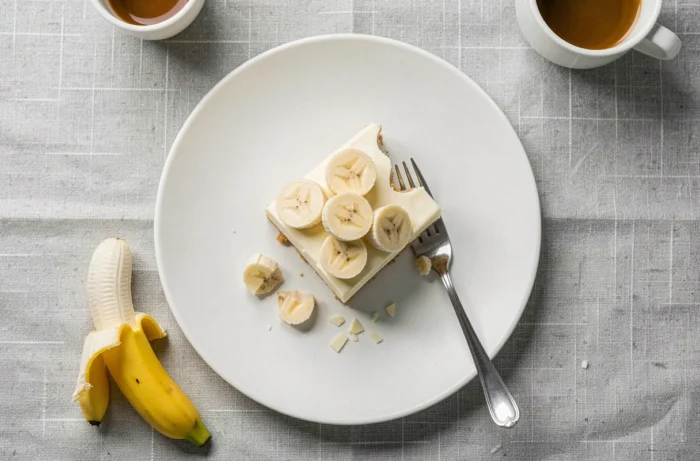
Storage and flavor evolution after resting
A detail that many recipes overlook: this cake is better the next day. Overnight, the moisture from the banana migrates evenly throughout the crumb. The aromas of the white chocolate, timid right out of the oven, develop at room temperature.
Wrap the cake while still warm in plastic wrap to trap the steam. This simple gesture prevents the crust from drying out while keeping the crumb melting.
At room temperature, the cake keeps for two to three days without losing its texture. In the refrigerator, it hardens because the cocoa butter solidifies. If you refrigerate it, take it out about thirty minutes before serving.
For longer storage, freezing works well. Slice the cake before freezing: you can defrost piece by piece in a few minutes at room temperature, without using the microwave which softens the crust.
Nutri-Score and white chocolate: what has changed recently
Since a decree signed on March 17, 2025, France has implemented a stricter Nutri-Score algorithm that penalizes products high in sugar more heavily. The penalty ceiling rises to 15 points for sugars. White chocolate bars, which are very sweet and high in saturated fats, are directly affected by this recalculation.
For homemade baking, this change has no direct impact on your recipe. Reducing the added sugar slightly is easy when using white chocolate, as it already contributes a significant amount of sugar and fat to the batter. Adjusting the proportions allows for a cake that is just as indulgent with a slightly more balanced nutritional profile.
The old and new Nutri-Scores currently coexist on shelves until March 2027. If you buy your white chocolate in bar form, the score displayed on the packaging may not necessarily reflect the new calculation.
The moist banana and white chocolate cake remains a dessert of pleasure. The real key to a suitable result lies in three points: very ripe bananas, white chocolate with real cocoa butter, and a barely mixed batter. The rest is the patience to let it rest overnight before tasting.