
We’ve all experienced that moment: the outfit is correct, the colors match, but the reflection in the mirror looks flat. It lacks a scarf tied in the right place, a belt that reshapes the silhouette, or a piece of jewelry that catches the light. Accessories do not just decorate a look; they construct it. And when we know which ones to choose, a modest wardrobe can give the impression of having been styled by a professional.
Accessories and Body Shape: Directing the Gaze Where You Want
Before discussing trends, let’s address a concrete problem that many overlook: a poorly placed accessory draws attention to the area you wanted to downplay. A wide belt worn on the hips visually broadens the hips. The same model, raised to the natural waist, defines the waist and elongates the legs.
The principle is simple. Each accessory creates a focal point, and the gaze of the observer stops there first. We can methodically exploit this mechanism:
- A short necklace or a scarf tied high shifts attention to the face and neckline, which is suitable when you want to visually lighten wide hips.
- A thin leather belt worn slightly above the navel creates a more pronounced shoulder-to-waist ratio, even on a straight dress without darts.
- A bag carried in hand (clutch, rigid pouch) visually shortens the torso, while a long crossbody bag does the opposite by elongating the silhouette.
- Dangling earrings elongate a round face, while wide hoops add width to narrow faces.
Among the accessories offered by Olivia Style, you’ll find pieces that precisely respond to this targeted enhancement logic, from belts to jewelry to scarves.

Transformative Pieces: Change Your Look Without Buying New Clothes
Image coaches are increasingly sharing a piece of advice that shakes up shopping habits: invest first in accessories, then in clothing. The reason is pragmatic. A basic black pant remains a basic black pant. Add a printed silk scarf tucked into the belt, a vintage brooch on the lapel of a solid blazer, and the perception changes completely.
This approach, known as “transformative pieces,” has gained traction over the past two years. It is based on a field observation: the majority of women rotate about ten garments. Rather than adding an eleventh, we multiply combinations with three or four well-chosen accessories.
High-Impact Accessories for a Controlled Budget
Not all accessories have the same transformative power. A jeweled headband or a structured hair clip can radically change a simple hairstyle, and by extension, the overall look. Linking the hairstyle to the rest of the look through hair accessories (ribbons, headbands, embellished clips) is an underutilized lever.
On the contrary, a discreet bracelet worn alone often goes unnoticed. Feedback on this point varies, but generally, you achieve more impact by concentrating the budget on a single statement piece rather than several small scattered accessories.
Layering Accessories: A Concrete Technique to Avoid Faux Pas
Layering necklaces, bracelets, or rings is an established trend, but if done poorly, it results in a messy outcome. The technique relies on a principle of variation in scale and material.
Start with a main piece (a metal choker, for example) and add a second, longer piece in a different material (a beaded necklace, a fine chain with a pendant). The contrast in length and texture creates depth without overload.
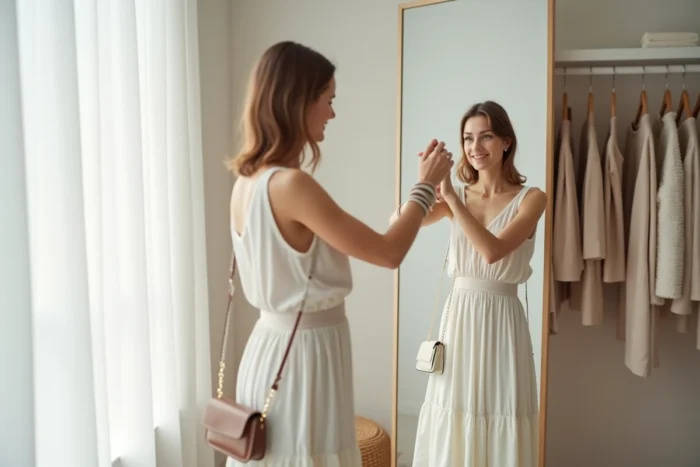
Three Common Mistakes in Layering
- Mixing more than two different metals in the same area (neck, wrists). Gold and silver work together, but adding copper or raw brass in the same spot muddles the look.
- Layering pieces of exactly the same length: they tangle, overlap, and lose their clarity. A gap of at least a few centimeters between each strand is necessary.
- Wearing large earrings at the same time as a bulky necklace. One statement area per outfit is enough to maintain balance.
Fashion Accessories and Virtual Try-On: Test Before You Buy
AI-assisted styling tools now allow you to visualize a complete look, accessories included, directly on your own photo. Applications like YouCam Perfect or Fotor offer the ability to virtually try on bags, jewelry, accessorized hairstyles, and belts before placing an order.
For online shopping, this capability changes the game. You can immediately see if a red scarf clashes with your complexion or if a structured bag disrupts a slender silhouette. Virtual try-on reduces purchase errors and the returns that follow.
This technology does not replace physical try-ons (the drape of a fabric, the weight of a piece of jewelry remain difficult to assess on screen), but it effectively filters out poor choices before they arrive in the package.
A well-chosen accessory does not just complete an outfit; it redefines it. Whether it’s a belt that reshapes an oversized dress or a headband that transforms a sleek bob into a styled hairstyle, the right reflex remains the same: identify the area to enhance, place the appropriate accessory there, and resist the temptation to add one too many.