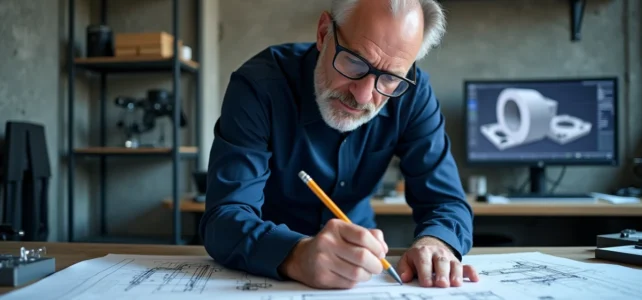
A custom industrial machine is equipment designed and manufactured to meet a production constraint that no standard equipment on the market covers. The starting point is not a catalog, but a technical specifications document specific to the company: production rates, tolerances, working environment, handled materials.
Technical specifications document: the foundation of a custom industrial machine
Before any modeling, the functional analysis phase determines the project’s viability. The goal is to translate an operational need (assembling, controlling, packaging, machining) into measurable specifications: cycle time, positioning accuracy, mechanical forces, space constraints.
This step radically distinguishes the design of custom industrial machines from an off-the-shelf purchase. The design office does not start from an existing template; it builds the mechanical, pneumatic, or hydraulic architecture around the client’s actual process.
A poorly defined specifications document generates costly iterations during the commissioning phase. The points to be locked down in advance include:
- The physical characteristics of the parts or products being handled (dimensions, weight, fragility, temperature)
- The target production rates and acceptable tolerance margins for each operation
- The applicable standards for the sector (food hygiene, pharmaceutical clean room, machine safety according to the Machinery Directive 2006/42/EC)
- The integration into the existing line, including mechanical and software interfaces with the equipment in place
A rigorous specifications document reduces the number of intermediate prototypes and shortens the time between design and production.
Customization of subsystems: where real performance is determined
General content about special machines focuses on automation and productivity. They often overlook a concrete lever: the customization of internal subsystems (hydraulic, pneumatic, motorization) that determines the operating cost over the entire lifespan of the equipment.
Hydraulic circuits tailored to the exact need
A custom-sized hydraulic system, with load detection and calibrated hydro-pneumatic accumulators, can reduce energy consumption by 20 to 50% compared to a standard circuit, according to data published by Universalflex. On a 15 kW motor running 4,000 hours a year, optimizing the hydraulic circuit can lead to a consumption reduction of up to 30%, with payback in the first months of operation.
This type of gain never appears in a standard machine quote because the circuit is fixed. Custom design allows for the selection of each hydraulic component based on the actual load profile.
Motorization and precision mechanics
The choice between servo motors, stepper motors, or direct drives depends on the torque, speed, and positioning accuracy required by the application. An assembly machine in micro-mechanics does not have the same needs as a food packaging line.
Adapting the motorization to the process avoids oversizing, which is a source of overconsumption and premature wear of mechanical components.
Additive manufacturing and prototyping in the design of special machines
Industrial 3D printing changes how design offices create certain parts of custom machines. Rapid prototyping shortens the functional validation phase by allowing the testing of complex geometries before final machining.
For low-volume parts or specific tooling, metal or technical polymer additive manufacturing offers a more favorable cost/time ratio than conventional machining. Positioning jigs, sensor supports, or part guides can be printed, tested, and corrected in a matter of days.
This approach does not replace precision machining for structural components subjected to high mechanical stresses. It serves as a complementary tool in the design process, particularly useful for validating the ergonomics of operator stations and the kinematics of mechanisms before series production.
Preventive maintenance and scalability: two often-overlooked design criteria
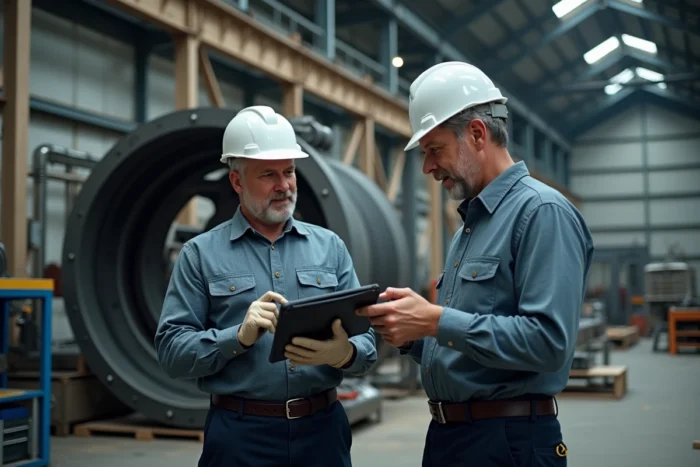
A well-designed special machine incorporates maintenance constraints from the outset. The accessibility of wear parts, the standardization of replaceable components, and detailed technical documentation condition the long-term ownership cost.
Too many projects focus on initial performance without anticipating routine interventions: replacing seals, recalibrating sensors, updating programmable logic controllers. An experienced design office plans for access hatches, disconnectable connectors, and interchangeable functional modules.
Scalability is another critical point. Production needs change: new product formats, increased rates, adding a quality control operation. A modular architecture allows for these changes to be integrated without redesigning the entire machine.
- Standardized mechanical and electrical interfaces facilitate the addition of stations or functions
- A programmable logic controller with spare input/output reserves allows for the integration of new sensors or actuators
- An oversized mechanical structure at the mounting points anticipates the addition of complementary modules
This architectural choice has a slightly higher initial cost, but it avoids the need to replace an entire piece of equipment when the process evolves.
The design of custom industrial machines relies on a balance between immediate performance and future adaptability. Companies that invest in a solid specifications document and a modular architecture reduce their total cost of ownership while maintaining the necessary flexibility to respond to market fluctuations.