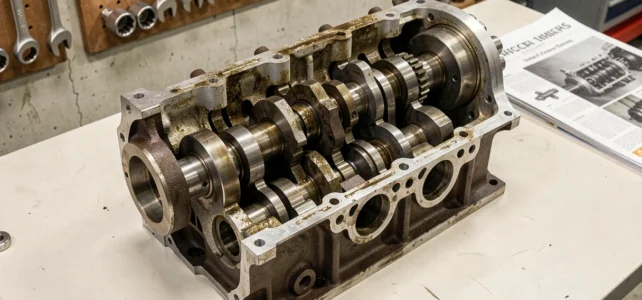
When replacing a conventional V engine with an X architecture in a competition vehicle or a restoration project, the first issue is not power. It’s the space under the hood and thermal management that dictate feasibility. The X engine, with its four rows of cylinders around a common crankshaft, compresses the length of the block, but this compactness comes at a cost in maintenance and cooling.
X Architecture and Engine Integration Constraints
An X engine arranges its cylinders in four banks forming an “X” when viewed from the front. Compared to a V engine with the same number of cylinders, the block is significantly shorter, freeing up longitudinal space in the engine compartment. On a compact chassis or a sports car with a reduced wheelbase, this gain changes the game for center of gravity positioning.
The direct trade-off is weight and mechanical complexity. Four rows of cylinders mean more cylinder heads, intake and exhaust circuits to route in a space that remains constrained in width and height. Feedback varies on this point depending on the setups, but accessibility for routine interventions (spark plug replacement, timing adjustments) is often trickier than with a conventional V6 or V8.
For those who want to delve deeper into the specifics of this configuration, detailed sheets can be found on the X engine on Motor X Club covering historical variants and contemporary applications.
Maintenance of the X Engine Compared to a V Architecture
In practice, the most frequently asked question concerns the actual maintenance cost. With an X engine, each maintenance operation takes longer than with an inline or V block, because accessing the lower banks sometimes requires partial disassembly.
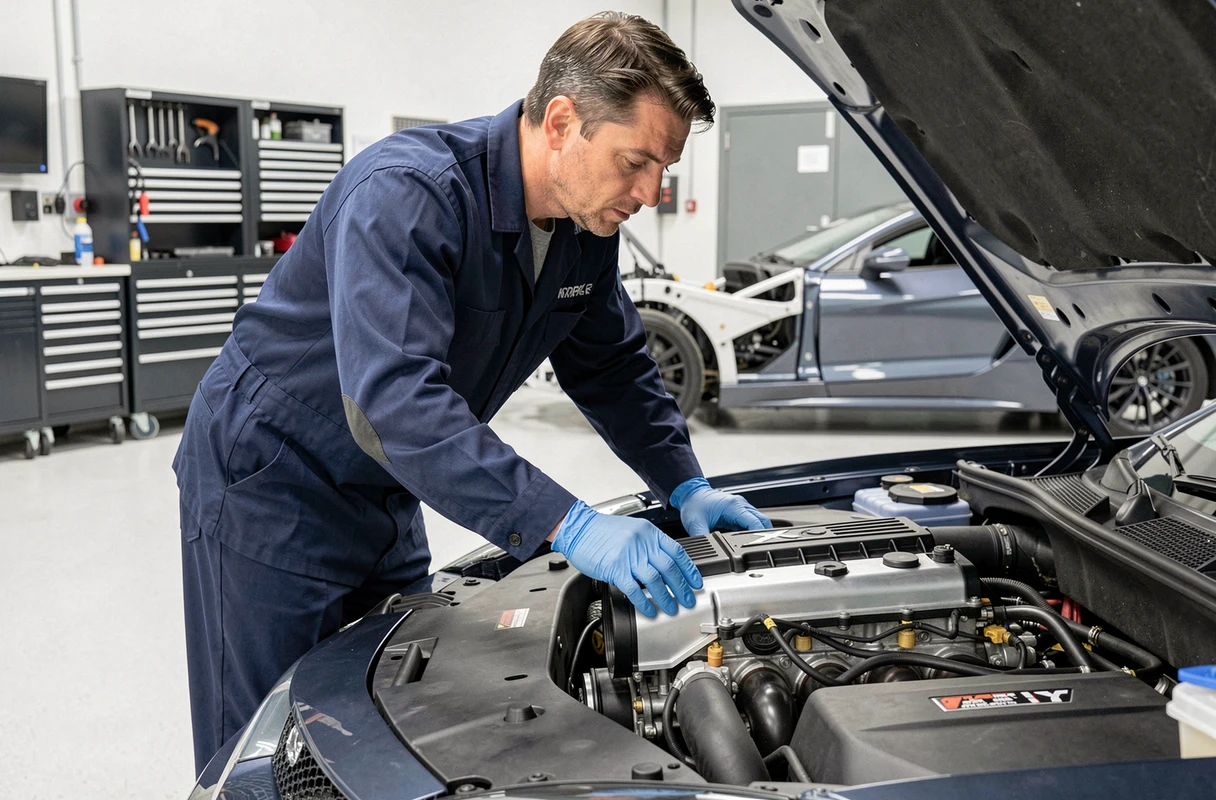
The cooling circuit is another critical point. Four rows of cylinders concentrated on a common crankshaft generate closely situated heat zones. The sizing of the radiator, the routing of hoses, and the flow rate of the water pump must be calibrated to avoid localized hot spots, especially on the banks least exposed to the frontal airflow.
In comparison, a conventional V8 distributes its cylinders over only two banks, with an angle that generally opens up airflow between the rows. This simplifies thermal diagnostic but sacrifices the longitudinal compactness provided by the X.
Maintenance Considerations
- Check the thermal balance between the four banks at each oil change by measuring the exhaust outlet temperatures per cylinder
- Plan for specific tooling access for the lower banks (articulated wrenches, flexible extensions), as standard tools often do not fit
- Monitor differential wear of the rings and sleeves, as the lower banks experience more oil fallout due to gravity
Single Block Integration: When It Becomes Cost-Effective
The current trend in the automotive industry is towards ultra-integration of powertrains. Nissan is developing an “X-in-1” architecture that concentrates multiple functions (electric motor, generator, inverter, reducer) into a single unit. The goal is not only to gain power but also to reduce noise and improve thermal efficiency of the associated thermal engine.
Geely takes this logic even further with its “Thunder” group developed by its subsidiary InfiMotion. The philosophy is to merge as many components as possible into a single block to optimize overall thermal management and system responsiveness. It is no longer a race for raw horsepower, but a balance between compactness, heat dissipation, and ease of replacement.
Range Extender: A Different Take on the Integrated Engine
Xpeng adopts a different approach with a gasoline engine that operates exclusively as an electric generator, with no direct mechanical link to the wheels. The thermal engine only serves to recharge the battery, which radically simplifies the transmission and reduces mechanical wear.
This hybrid range-extender configuration changes the usual comparison framework. One no longer compares an X engine to a V engine based on torque or maximum RPM. The question becomes: at what point does an integrated block, whether purely thermal or hybrid, cost less to maintain over time than a traditional architecture with its separate components?
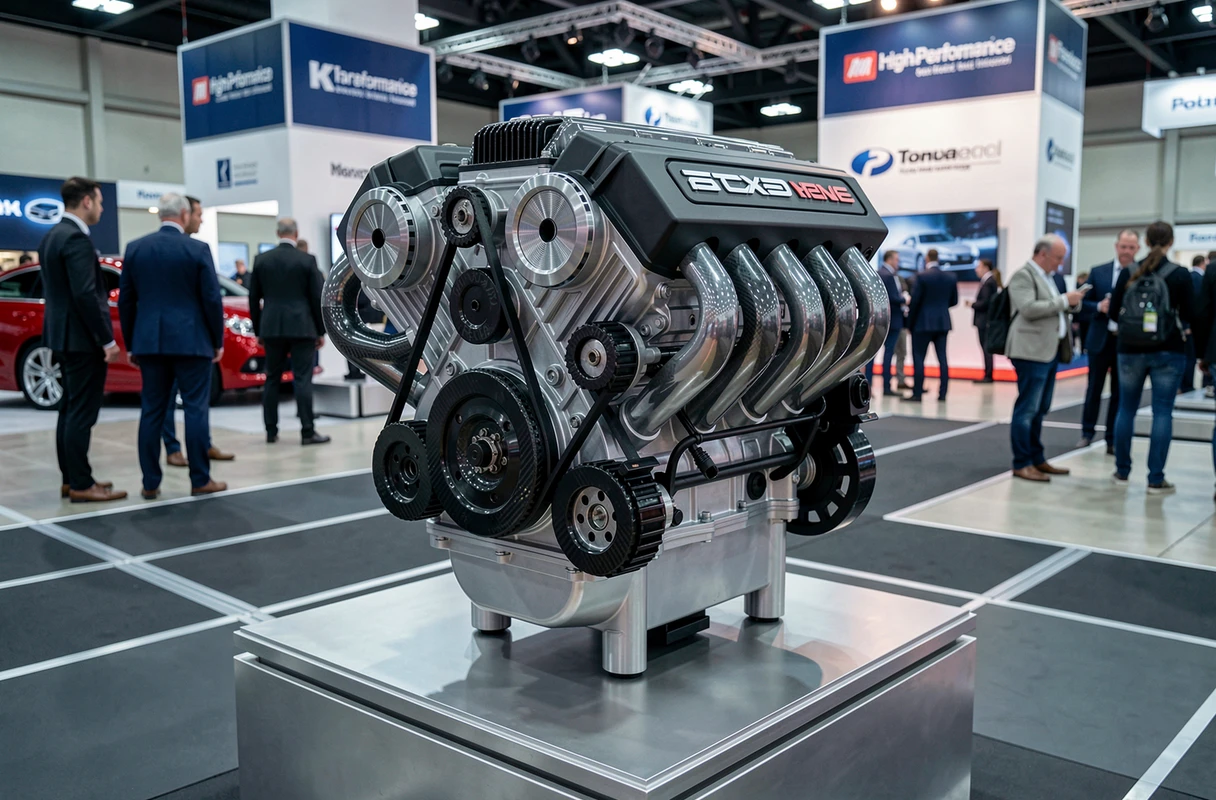
Performance and Scalability of the X Engine for Competition
In motorsport, the X engine has found niche applications where compactness takes precedence over everything else. Its compact shape allows it to be installed lower in the chassis, which lowers the center of gravity and improves dynamic behavior in corners.
Scalability remains the weak point of this architecture. Adding power to an X engine involves increasing displacement or forced induction, but each modification impacts all four banks simultaneously. The tuning work is multiplied compared to a V8 where one can intervene bank by bank.
- Gain in compactness: the X engine occupies significantly less length than an equivalent V, freeing up space for the radiator or intercooler
- Weight penalty: the four-bank structure and reinforced oil pan add weight compared to a V of the same displacement
- Complexity of forced induction: routing four intake manifolds to one or two turbos requires custom piping work
The choice between an X engine and a conventional architecture is not just a technical specification. It is a global trade-off between bulk, maintenance budget, thermal management, and the ability to evolve the block over time. For road use, modern integrated solutions are gaining ground. For a competition project where every centimeter counts, the X still has a card to play.