The protea survives bushfires. The lotus grows in the mud. The poppy recolonizes war-torn soils. In floriography, resilience and courage are not abstractions: they are botanical responses to extreme conditions, codified by centuries of symbolism.
Protea and fire resistance: the botany behind the symbol of strength
The protea takes its name from Proteus, a Greek deity capable of changing form. This etymology is not anecdotal: it reflects the remarkable adaptability of the genus Protea, native to southern Africa.
We observe that the protea regenerates after a forest fire, a mechanism called serotiny. Its seeds remain enclosed in woody bracts that only open after exposure to intense heat. The fire destroys the parent plant but releases the next generation onto a fertile bed of ashes.
This cycle of destruction and rebirth makes it one of the flowers most explicitly associated with resilience in contemporary bouquets. Florists offer it to mark a period of personal reconstruction, a divorce, or a recovery. The growing interest in the flower of resilience and courage in floral arrangements confirms this trend.
In a bouquet, the protea often stands alone. Its massive head and shades ranging from pale pink to deep purple convey an unequivocal visual message. We recommend choosing it for its symbolic impact as much as for its vase life, which is significantly superior to that of most cut flowers.
Lotus: meaning of colors and symbol of rebirth
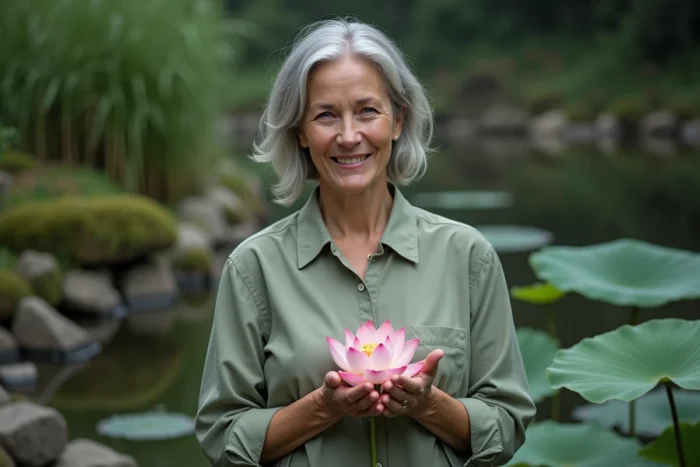
The lotus occupies a special place in the language of flowers. Its growth in stagnant, muddy waters before blooming on the surface constitutes the most direct botanical metaphor for spiritual resilience.
The symbolism varies according to the color of the petals:
- White lotus: mental purity and spiritual elevation, associated with Theravada Buddhism and meditation.
- Pink lotus: flower of the historical Buddha, symbol of compassion and an open heart after trial.
- Blue lotus: wisdom and mastery of the senses, common in ancient Egyptian iconography.
- Black lotus: emerging in tattoo and digital iconography, it specifically represents resilience after a breakup or mourning.
The black lotus deserves special attention. Its recent adoption in tattoo designs reflects a need to carry a visible reminder of one’s own ability to withstand adversity. It is no longer a religious reference: it is a contemporary body language.
Lotus and poppy: two logics of resilience
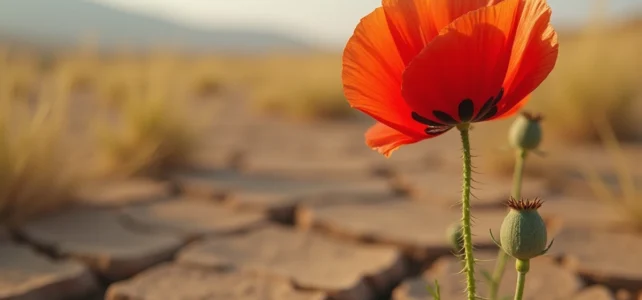
The poppy shares with the lotus this relationship to degraded soil. In Flanders and on the Somme, it has recolonized the battlefields of World War I, becoming a symbol of memory and persistent life. However, its meaning differs: while the lotus embodies inner transformation, the poppy symbolizes collective memory and hope after conflict.
In floral composition, the two rarely work together. The poppy, fragile in a vase, is more suited to memorial gardens and illustrations. The lotus, on the other hand, remains primarily a symbol worn as jewelry, tattooed, or graphically represented.
Giving a bouquet of courage: flower choices and color codes
Floriography is not limited to choosing a species. The color of the bouquet radically alters the message conveyed.
Red, often reduced to romantic love through the rose, also carries a dimension of strength and determination. A red rose given to someone recovering does not say “I love you”: it says “fight.” The context makes the message.
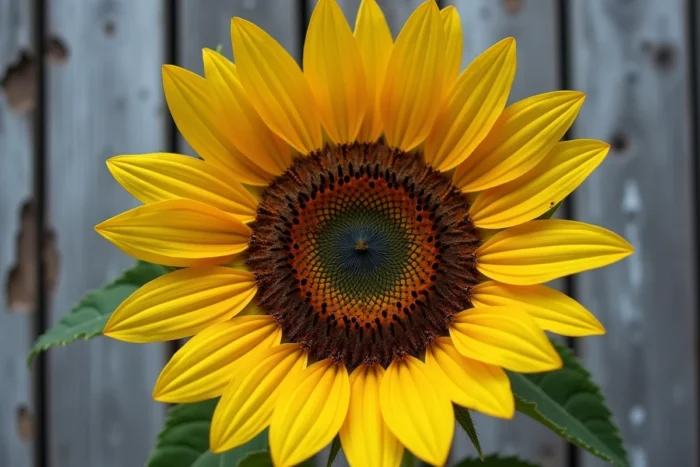
Yellow remains the most reliable color to express joy and hope without sentimental ambiguity. The yellow chrysanthemum, far from its French funeral connotation, symbolizes health and happiness in most Asian cultures. The yellow or orange gerbera conveys direct encouragement without excessive solemnity.
White requires more caution. Associated with purity, it can easily slip into mourning in certain cultural contexts. We recommend reserving it for mixed arrangements rather than monochromatic bouquets when the intention is comfort.
Composing a bouquet with a clear message
Three criteria guide a bouquet intended to express courage:
- Choose a flower with explicit symbolism (protea, silk lotus, dahlia for its persistence) rather than a versatile flower whose meaning remains vague.
- Combine a maximum of two colors to avoid dispersing the message: yellow and white for hope, pink and purple for rebirth.
- Favor flowers with long vase life (chrysanthemum, dahlia, protea) so that the supportive gesture remains visible for several days, extending the comforting effect of the bouquet well beyond the moment.
Snowdrop and cherry blossom: seasonal courage in the floral language
The snowdrop is the first flower to brave the winter cold. Its fragile stem literally breaks through the layer of snow, making it a symbol of hope and renewal in European traditions. Giving snowdrops in January or February carries a precise message: the end of the trial is near.
In Japan, the cherry blossom (sakura) embodies a different form of courage. Its spectacular yet fleeting bloom reminds us that beauty also arises from fragility and impermanence. The hanakotoba, the Japanese language of flowers, associates sakura with nobility of soul and acceptance of the passage of time.
These two flowers share a common trait: their bloom is brief. The message they carry rests on this short temporality. Unlike the protea or chrysanthemum, they do not last. Their symbolism functions in the moment, which paradoxically enhances their emotional weight.
Choosing a flower to express resilience is akin to choosing vocabulary. Each species, each color carries a distinct nuance. The gesture is not trivial: a well-composed bouquet sometimes replaces words that no one knows how to say.