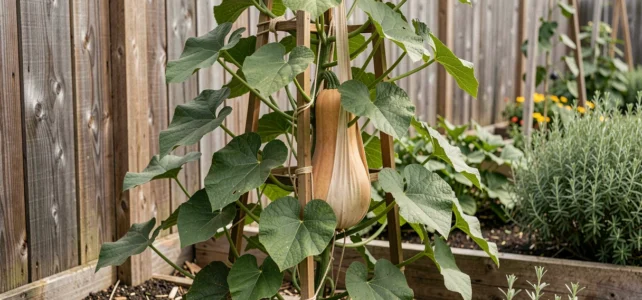
Butternut squash is a sprawling gourd whose stems can exceed several meters in length. Growing this squash vertically involves redirecting its growth upwards, onto a support, instead of allowing it to crawl on the ground. This principle modifies space management, air circulation around the foliage, and the plant’s behavior against fungal diseases.
Support load and anchoring: the technical point that guides underestimate
A butternut fruit reaches a significant weight at maturity. Therefore, the vertical structure must be sized according to this load, not just the height of the plant. A lightweight plastic trellis or fine mesh is not sufficient: it risks bending or even toppling once the first fruits are formed.
Prefer a treated wood panel, welded metal trellis, or a galvanized steel arch. The critical point is the anchoring to the ground or wall. Stakes driven in shallow do not withstand the wind combined with the weight of the squashes. Secure the structure with stakes at least half its height, or bolt it to a load-bearing wall.
Mastering the vertical cultivation of butternut starts with this sizing, even before addressing seeding or variety.
Progressive staking of butternut: guiding without breaking
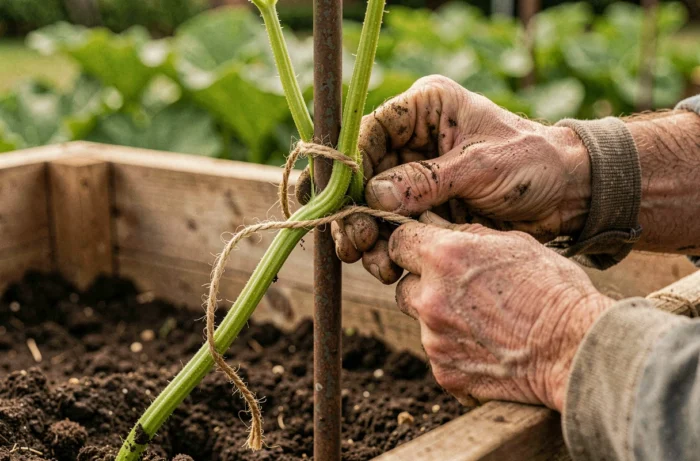
Butternut does not cling to a support like a climbing bean would. Its tendrils are weak and its stems brittle when forced too quickly. Staking must be progressive, accompanying growth every three to five days.
Use soft ties (fabric strips, rubber ties, wide jute twine) to secure the main stem to the support without strangling it. The stem grows quickly: a tight tie today will cut into the bark in a week and create an entry point for pathogens.
Managing secondary stems
Allow the main stem to grow and limit lateral branches to two or three secondary stems. Remove the others by pinching them at the base. This pruning channels the plant’s energy towards fewer fruits, but of better quality. On a vertical support, too many lateral stems destabilize the structure and complicate harvesting.
Supporting suspended fruits on the trellis
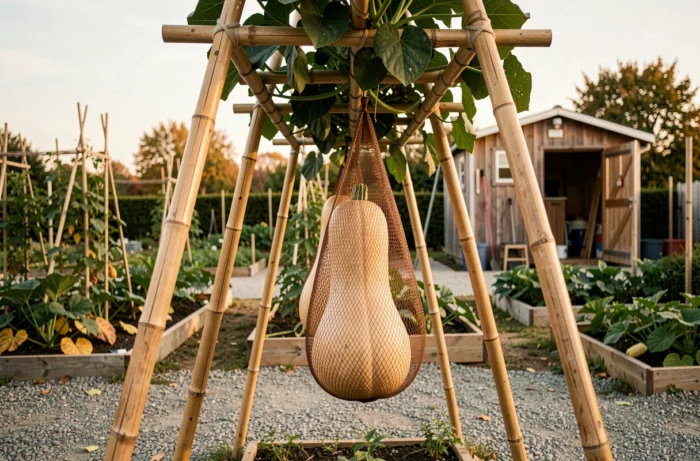
A butternut growing in height is subject to gravity. Without individual support, the fruit pulls on the peduncle and may detach before maturity or deform the stem. The most reliable technique is to make support hammocks with fine mesh netting or an old nylon stocking, tied directly to the support.
- Install the hammock as soon as the fruit exceeds the size of a tennis ball, not later.
- Attach the net to the trellis (not to the stem) so that the weight rests on the structure and not on the plant.
- Check weekly that the net does not compress the fruit as it grows: widen or change the support if the squash takes on a flattened shape.
This simple action makes the difference between a successful vertical harvest and fruits that fall to the ground before maturity.
Watering and humidity of foliage in vertical cultivation
Butternut needs regular and deep watering at the base, not on the surface. In vertical cultivation, the foliage dries faster after rain due to better air circulation. This is a real health advantage: fungal diseases like powdery mildew mainly develop on leaves that remain wet for long periods.
Water directly at the base, preferably in the morning, avoiding wetting the leaves. A thick mulch on the ground (straw, wood chips) retains moisture at the root level and limits evaporation. The staked butternut has the same water needs as a sprawling plant, but the soil around the base can dry out faster when the foliage no longer shades the ground.
Identifying water stress on a vertical plant
Leaves that wilt in the middle of the day and then perk up in the evening do not necessarily indicate a lack of water; it is a normal reaction to heat. However, leaves that are still limp in the morning indicate insufficient watering. Increase the frequency without drowning the base: constantly waterlogged soil causes root rot.
Pollination at height: a often overlooked harvest factor
Butternut produces male and female flowers on the same plant. Pollination depends on insects, mainly bees and bumblebees. When flowers are located high on a trellis, they may be less visited than flowers on the ground, depending on the garden environment.
If your first female flowers abort (the small fruit yellows and falls), pollination is likely insufficient. The most direct solution is manual pollination: take an open male flower in the morning, remove the petals, and rub the pollen on the pistil of the female flower.
- The female flower is recognized by the small swelling (future fruit) at its base.
- Intervene early in the morning, when the flowers are freshly opened and the pollen is still abundant.
- One pass per flower is sufficient if the pollen-pistil contact is clear.
This action takes less than a minute per flower and secures the harvest, especially in urban gardens where pollinators are scarce.
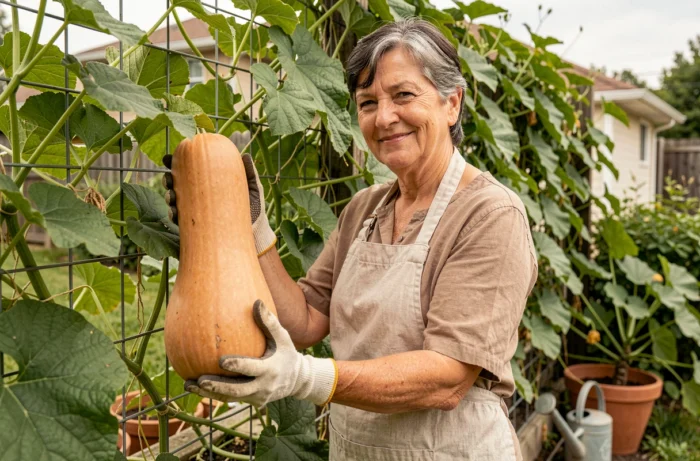
The success of a vertical butternut relies on three repeated actions throughout the season: guiding the stems without forcing them, supporting each fruit as it grows, and monitoring the pollination of the first female flowers. The rest (rich soil, sunny exposure, watering at the base) does not change compared to ground cultivation. Verticality frees up space in the vegetable garden, but it requires more regular attention to the plant.