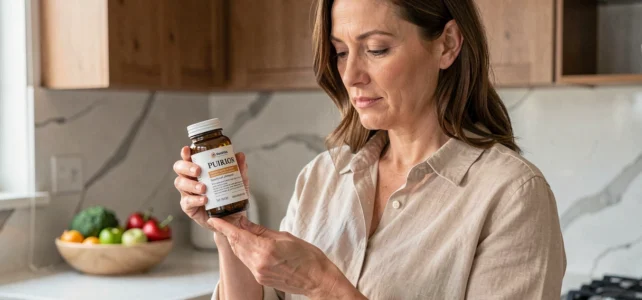
Safralite is a dietary supplement from the CODIFRA laboratory formulated around saffron, griffonia, vitamin B6, and zinc. Its official positioning concerns mood and emotional balance, not weight management. However, the question arises regularly: can this product cause weight gain, or conversely, help with weight loss? The answers deserve a more precise examination than the usual shortcuts.
Emotional snacking and sweet cravings: the real lever of Safralite on weight
CODIFRA does not present Safralite as a weight loss product. Its claimed action focuses on emotional balance, through saffron and griffonia (a source of 5-HTP, a precursor to serotonin). This positioning is crucial to understanding the supposed link with weight.
The most plausible mechanism, if there is an indirect effect on weight, would be through the regulation of emotional appetite. When serotonin levels are better supported, compulsive cravings for sugar or snacking related to stress or low morale tend to decrease. Safralite does not act on energy metabolism but on eating behavior.
This distinction changes everything. A supplement that reduces sweet cravings at the end of the day does not “burn” any calories. It potentially modifies the amount of food ingested during these episodes. The effect on the scale therefore entirely depends on the individual’s profile: someone who does not snack under stress will see no weight change. To delve deeper into the subject, a file dedicated to safralite and weight gain on Pur Bien-Être details these behavioral mechanisms.
Safralite and weight gain: what clinical data does not say
No published clinical study specifically addresses Safralite and weight variation. Existing research on saffron or griffonia taken separately explores their effects on mood, sometimes on appetite, but not in the exact formulation of this supplement.
The available data do not allow us to conclude that Safralite causes weight gain or loss. Field reports vary on this point: some users report a decrease in cravings, while others notice no change. These isolated testimonies do not constitute proof.
Griffonia, through its action on serotonin, could theoretically reduce appetite in some individuals. However, nothing in the product’s composition (saffron, vitamin B6, zinc) has any known property that promotes fat storage or water retention. No ingredient in Safralite is associated with a direct “weight-gaining” effect.
Composition of Safralite: each ingredient scrutinized
To assess the risk of weight gain, it is necessary to examine what the product actually contains:
- Saffron (Crocus sativus) is studied for its properties on mood. Some preliminary research suggests a moderating effect on appetite, but results remain to be confirmed on a large scale.
- Griffonia simplicifolia provides 5-HTP, a precursor to serotonin. This neurotransmitter plays a role in satiety, which explains the hypothesis of an indirect appetite-suppressing effect.
- Vitamin B6 contributes to the normal metabolism of macronutrients and the functioning of the nervous system. It has no known effect on weight gain or loss at the doses present in a dietary supplement.
- Zinc is involved in the metabolism of carbohydrates and fatty acids. Again, at the dosages of a supplement, no measurable weight impact is documented.
The formula of Safralite contains neither added sugar nor significant caloric excipients. One capsule represents a negligible energy contribution. The idea that a supplement of this type could, by its mere composition, cause weight gain is a myth.
Saffron, mood, and diet: why the confusion persists
The confusion between a mood supplement and a weight loss product can be explained by a logical shortcut. If a product improves morale and morale influences diet, then the product influences weight. The reasoning is not absurd, but it skips several steps.
Chronic stress pushes part of the population towards foods high in sugar and fat. This phenomenon, sometimes called “emotional eating,” is well documented. Reducing stress does not guarantee weight loss if eating habits remain unchanged.
A supplement like Safralite can, at best, contribute to a more stable emotional environment. The transition from this stable environment to a real change in weight depends on factors that the product does not control: physical activity, overall diet quality, sleep, hormonal context.
Side effects of Safralite: should you monitor your weight during the course
The reported side effects for Safralite remain rare and generally mild (slight digestive disturbances). No pharmacovigilance signal mentions weight gain as a side effect of the product.
However, there is an indirect trap. Some people who start a mood supplement simultaneously discontinue a medical treatment (antidepressant, anxiolytic) for which weight gain was a known side effect. The observed weight change is then linked to the cessation of the medication, not to the introduction of Safralite. Any treatment modification should be done with medical supervision.
- Follow the dosage recommended by the manufacturer (usually one capsule per day).
- Do not combine Safralite with other supplements containing 5-HTP without medical advice, to avoid excess serotonin.
- Consult a healthcare professional if unusual weight variations occur during the course.
The product is not a substitute for nutritional or psychological support. It fits, at best, as a supplement in a comprehensive approach to emotional balance. Expecting Safralite to alter body composition assigns it a role that neither its formulation nor current evidence justifies.