
The thickness of a pair of glasses depends on several technical parameters that most wearers discover at the time of payment, not before. Correction in diopters, the refractive index of the material, frame size: these three variables interact and determine both the weight on the nose, the visual rendering behind the frame, and the final price.
Understanding their mechanics prevents ending up with lenses that are too heavy or an unnecessary extra cost for thinning that has no real effect.
Thickness of glasses: what the standard imposes before any aesthetic choice
Before discussing thinning, it is essential to set a framework that purchasing guides almost always overlook. The standard NF EN ISO 21987 establishes the acceptable tolerances for mounted corrective lenses. In spherical power, the allowed deviation is ±0.12 diopter up to 6.00 diopters, and ±0.18 diopter beyond that.
These thresholds also frame the centering and the prismatic effect. A lens that is too thin may fall outside these tolerances, meaning the actual correction delivered differs from that prescribed. Thinning thus has a normative limit, not just a budgetary one.
In practice, an optician who offers a very high index on a moderate correction does not save much in thickness but increases the price. Conversely, on a strong correction, refusing thinning for economic reasons can result in an oversized lens for certain thin frames. The compromise lies between the optical precision guaranteed by the standard and the desired aesthetic result.
To estimate the final thickness before ordering, Pharmidea’s lens thickness tool allows you to simulate the result based on the chosen correction and index, which helps make decisions without solely relying on the optician’s quote.
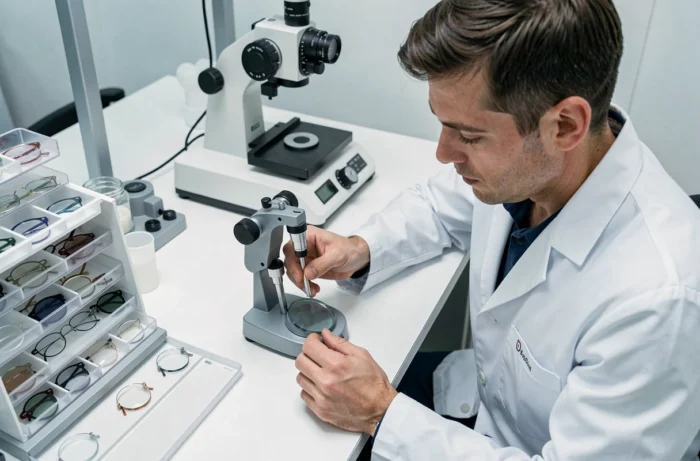
Refractive index of lenses: what thinning for which correction
The refractive index measures a material’s ability to bend light. The higher the index, the less thickness the lens needs to achieve the same correction power. Common indices range from 1.50 (standard glass) to 1.74 (the thinnest available in organic materials).
Low and medium corrections
For a correction of less than about two diopters, a lens with an index of 1.50 remains sufficiently thin for most frames. Moving to an index of 1.60 brings a minimal difference in thickness, often imperceptible once the lens is mounted. The extra cost is not justified in terms of visual comfort.
Between two and four diopters, the index of 1.60 represents the best balance between thickness and cost. The gain in thinness becomes visible, especially on larger frames where the edge of the lens (in myopia) or the center (in hyperopia) thickens quickly.
Strong corrections beyond five diopters
It is from this threshold that the choice of index truly changes the wearing experience. A lens with an index of 1.50 in high myopia produces thick edges that extend beyond the rim and weigh down the frame. Indices of 1.67 and 1.74 significantly reduce this edge thickness.
An index of 1.74 on a strong correction can halve the edge thickness compared to a standard index. The gain is also reflected in weight, which reduces marks on the nose and fatigue at the end of the day. However, very high index lenses exhibit slightly higher chromatic dispersion (aberration), a parameter rarely mentioned in field feedback but which can bother wearers sensitive to light halos.
Frame size and pupillary distance: two parameters that change everything
The refractive index is only part of the equation. Two wearers with the same correction and index can achieve very different thicknesses depending on their frame and pupillary distance.
- A wide frame (caliber over 54 mm) requires more material to be retained at the edges for a myope, or at the center for a hyperope. Choosing a smaller frame is sometimes more effective than increasing the index by one notch.
- A pupillary distance that is far from the geometric center of the frame creates a decentration of the lens. The greater the offset, the thicker the lens becomes on the side opposite the nose. The optician can compensate by ordering a reduced diameter of raw lens, but this requires checking feasibility with the chosen frame.
- A small round frame combined with good centering reduces thickness more effectively than a jump in index on an oversized frame. This lever is free, unlike changing the index.

Material of glasses: organic, polycarbonate or mineral
The choice of material not only affects thickness but also impact resistance, weight, and perceived optical quality.
Organic glass (CR-39 for index 1.50, resins for higher indices) dominates the market. It is lightweight, easy to tint, and compatible with most anti-reflective treatments. Almost all lenses sold today are organic, with mineral lenses becoming marginal due to their weight and fragility to impacts.
Polycarbonate (index 1.59) offers significantly superior impact resistance, making it relevant for sports glasses or equipment intended for children. However, its optical quality is slightly inferior to that of an organic lens of the same index, with more chromatic aberrations.
- Trivex, similar to polycarbonate in strength, partially corrects this optical defect while remaining very light. Its index (around 1.53) positions it for low to medium corrections.
- For wearers who work in high-risk environments, eye protection standards (EN 166 and its update EN ISO 16321) impose minimum thicknesses that may conflict with the pursuit of thinning. A certified protective lens cannot drop below a certain threshold of mechanical resistance.
- Surface treatments (anti-reflective, anti-scratch, blue light filter) do not influence the thickness of the lens itself but add a few microns of coating. Their impact is invisible to the naked eye.
Price of thinned lenses: when the investment is justified
The transition from one index to another represents a variable extra cost depending on the retailers and manufacturers. Market trends push high-index lenses towards a premium product position, maintaining significant price differences between a 1.50 and a 1.67 or 1.74.
The extra cost is only worthwhile when it produces a noticeable gain in thickness. For a correction of less than two diopters, paying for an index of 1.67 amounts to buying marginal comfort. For a correction of six diopters or more, the high index literally transforms the worn frame.
The best lever for savings remains to combine a suitable frame (small, well-centered) with just enough index for the correction. An optician who systematically offers the highest index without considering the chosen frame does not necessarily provide the best advice.
The ideal thickness of a pair of glasses does not exist in absolute terms. It results from a trade-off between prescribed correction, selected frame, chosen material, and available budget. The only reliable shortcut is to simulate the result before ordering, then verify with the optician that the lens meets the normative tolerances once mounted.