
The Scott Speedster 60 holds a special place in the Scott catalog: it is the entry-level road bike that borrows the endurance geometry from higher-end models. With its elongated head tube and upright position, it targets cyclists who want to cover miles without pain rather than chase KOMs on Strava. We rode it for several weeks to see if this promise holds true.
Endurance geometry of the Scott Speedster 60: what it really changes
Have you ever felt that tension in your neck after two hours on an overly aggressive road bike? This is precisely the problem that the Speedster’s geometry aims to solve.
The frame features a longer head tube than a competition-oriented bike. Translated into sensations, this means that the torso remains more upright, with the arms slightly less stretched. The lower back and neck are less strained on long rides. This is not a cosmetic detail: on a three or four-hour ride, this difference in posture is clearly felt.
Stability is also part of the package. The Speedster 60 does not seek the nervousness of a racing frame. It prioritizes predictable handling in descents and medium-speed corners. For a cyclist discovering the road or returning after a long break, this is a tangible advantage.
We detailed our observations in the review of the Scott Speedster 60 after several hundred kilometers on hilly and flat routes.
Aluminum frame and Shimano drivetrain: the performance-price compromise
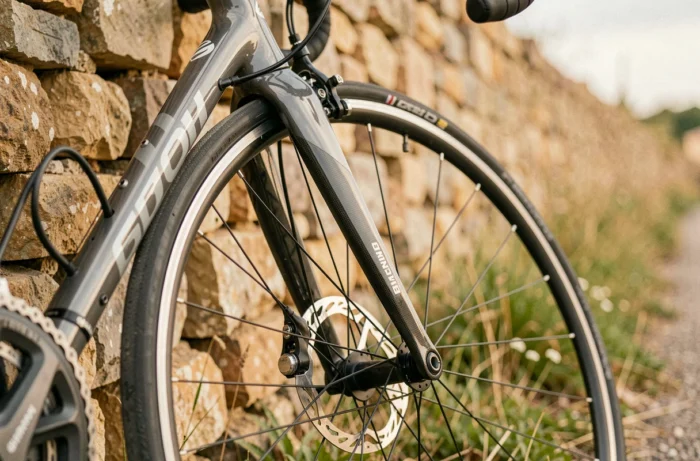
The frame of the Speedster 60 is made of aluminum. Compared to the carbon of the Addict models or higher-end Speedsters, there is a weight difference. In practice, this is mainly noticeable during accelerations and steep climbs.
On flat or rolling terrain, the aluminum of the Speedster is easy to forget. The frame transmits power well without a feeling of softness. It is on short, steep climbs that you feel the difference with a carbon bike: the acceleration requires a bit more effort, and the bike does not “spring” under acceleration.
What the drivetrain is worth at this price level
The Speedster 60 comes equipped with an entry-level Shimano drivetrain. The gear shifts are functional, without the surgical precision of a 105 or Ultegra groupset. Gear changes remain reliable under moderate load, which covers the vast majority of situations in recreational or sporty outings.
One point deserves attention: the front derailleur may require some adjustment time if you come from a bike equipped with a higher-level Shimano. The shift from the small to the large chainring is a bit less smooth, especially uphill when the chain is under tension.
- The aluminum frame offers a good stiffness-to-price ratio, suitable for regular rides without competitive goals
- The Shimano drivetrain ensures correct gear changes, with proven long-term reliability
- The original wheels do their job but are the first area for improvement for those wanting to gain in dynamism
Comfort on the road and sensations of the Speedster 60 on long distances
The comfort of a bike is not limited to geometry. Tires, saddle, and the frame’s ability to filter vibrations play at least as significant a role.
On rough roads, the Speedster 60 shows tolerance. Aluminum transmits more vibrations than carbon, this is a physical fact. But the endurance geometry compensates to some extent: the upright position reduces pressure on the hands and wrists, which alleviates fatigue related to micro-shocks.
The original tires accept moderate inflation, which further improves filtering. Lowering the pressure by a few bars from the maximum indicated on the side transforms the behavior on granular secondary roads.
Feelings in descent and in the peloton
On fast descents, the Speedster 60 inspires confidence. The frame does not float, and the steering remains stable even on degraded surfaces. This is not a bike that encourages attacking every corner, but it forgives approximate lines.
In a group, the bike holds its place without issue. Braking remains progressive and sufficient for riding in a tight peloton. The only noticeable limit concerns sharp accelerations out of corners: the weight of the frame and wheels is felt compared to better-equipped companions.

Wheels and tires of the Speedster 60: the first upgrade to consider
The original wheels mounted on the Speedster 60 are the component that most limits the frame’s potential. They are heavy compared to current standards, which affects acceleration and climbing behavior.
Why this choice? On a bike at this price level, wheels are the area where manufacturers save the most. The frame and drivetrain maintain a good level, but the wheels absorb the budget constraint.
Changing the wheels is the most cost-effective upgrade on this bike. A pair of mid-range aluminum wheels, lighter and with better bearings, transforms the sensations. The bike becomes more lively in acceleration, more responsive in climbs, and the cruising speed on flat terrain increases significantly.
- Lighter wheels improve acceleration and climbing behavior without altering the frame
- Higher quality tires increase grip and comfort, especially on wet roads
- A saddle change suited to your morphology reduces discomfort on long rides
Scott Speedster 60: for which type of cyclist
The Speedster 60 is not a competition bike disguised as a leisure bike. It is a true entry-level endurance bike, with the qualities and limits that this entails.
It is particularly suitable for cyclists who are starting on the road after practicing mountain biking or fitness, for those returning to cycling after several years, or for regular riders who do not aim for racing but want a reliable frame for a few hours of riding.
The Speedster 60 does not claim to compete with the carbon models in the Scott range. It offers a solid, comfortable, and adaptable base. With a reasonable budget for better wheels and suitable tires, it becomes a road companion capable of lasting several seasons.