
The Yamaha Xmax 125 displays a top speed that varies significantly according to reports: some owners report ceilings around 110 km/h on the speedometer, while others claim 120 km/h or more. These discrepancies are not solely explained by the engine. The weight of the rider, the condition of the transmission, tire pressure, and even the Euro standard of the model all play a measurable role in the actual maximum speed.
Speedometer speed and actual speed of the Xmax 125: the gap that skews everything
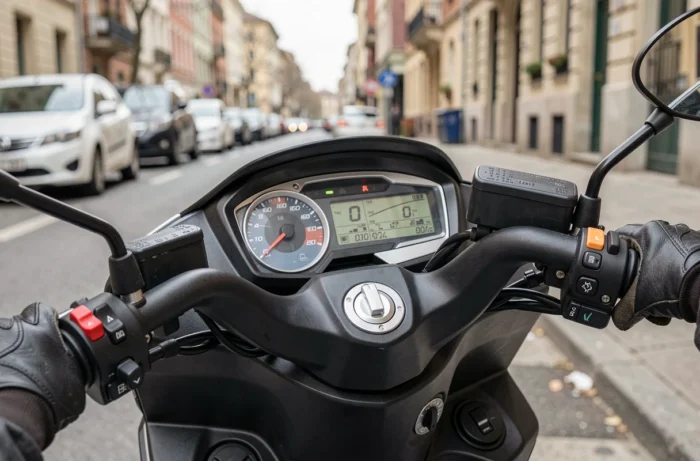
Before trying to gain a few km/h, one fact needs to be established: the speedometer of the Xmax 125 overestimates the actual speed. Recent tests emphasize this distinction, and numerous forum feedback comparing GPS and speedometer confirm a gap of several km/h in favor of the display.
A rider reading 120 km/h on the speedometer is likely traveling slower in reality. This overestimation skews most online discussions about “top speed,” as users compare speedometer figures without GPS correction.
To honestly assess the max speed of the Xmax 125 cm3, it is therefore essential to systematically distinguish the displayed value from the measured value. Without this precaution, any optimization attempt starts from a biased foundation.
Measurable factors that reduce top speed
Several concrete parameters explain why one Xmax 125 may not reach the same speed as another. The differences can be surprising between two scooters of the same model year.
Rider weight and cargo load
A rider weighing 110 kg on a Xmax 125 cannot expect the same top speed as a rider weighing 70 kg. User feedback on specialized forums confirms this: an owner weighing 110 kg reports a ceiling of 110-120 km/h on a 2019 model.
When riding two-up with luggage, the usable speed drops by about fifteen km/h compared to solo riding. On Euro 5+ versions, practical ceilings then hover around 90-100 km/h on the speedometer under favorable conditions. This data is rarely mentioned in discussions focused on engine tuning.
Condition of the transmission: belt, rollers, springs
The variator transmission is the most sensitive link to wear on a Xmax 125. A loose belt or worn rollers alters the variation range and limits the engine speed before it reaches its maximum power.
- Rollers that are too heavy or too light shift the variation point and prevent the engine from revving up in the last few km/h.
- An original belt with more than 12,000 km on the clock loses rigidity, which reduces the efficiency of the transmission at the end of the variation.
- The push spring (clutch counter-pressure) directly affects the engine’s ability to maintain high revs under load.
Tire pressure and rolling resistance
The tires of the Xmax 125 (120/70-15 at the front, 140/70-14 at the rear) have a direct impact on rolling resistance. A slight under-inflation of a few tenths of a bar is enough to create noticeable drag beyond 100 km/h.
Having tires at the correct pressure is the simplest and least expensive gain. Checking the pressure when cold every two weeks remains the first thing to do before considering any modifications.
Xmax 125 transmission tuning: what the kits really change
Replacing the original variator with a Malossi Multivar type variator is the most common modification. Tuners offer kits (variator, rollers, sliders, push spring) installed for a price around 175 euros including installation on Euro 3 versions.
| Modified Element | Main Effect | Impact on Top Speed |
|---|---|---|
| Malossi Multivar Variator | Wider variation range, better engine revs | Several km/h at top speed, mainly acceleration gain |
| Rollers suited to rider weight | Optimization of the variation point | Allows reaching the appropriate revs faster |
| Reinforced push spring | Maintains revs under load | Stabilizes max speed uphill or two-up |
| New belt (Yamaha original) | Efficient power transmission | Recovers km/h lost due to wear |
The actual gain in pure top speed remains modest on a 125 limited by its displacement. The most noticeable improvement is felt in acceleration and responsiveness, not in the last km/h on the speedometer.
ECU reprogramming and legal limits on a Xmax 125
Since 2025, Xmax 125 models equipped with the Blue Core Euro 5+ engine come with a very conservative engine management. The injection mapping prioritizes emissions and fuel consumption over performance, which reduces the usable margin for reprogramming.
The regulatory constraint is structural: the A1 homologation imposes a ceiling of 11 kW (15 hp). Any reprogramming that exceeds this limit falls outside the legal framework.
Under French law, any significant modification of power, torque, or maximum speed compared to the original specifications must be declared. In the event of an accident with a scooter whose mapping has been modified without declaration, the insurer may refuse coverage. This risk is documented and is not a theoretical hypothesis.
- An undeclared reprogramming constitutes a modification of the vehicle’s technical characteristics.
- The insurance can invoke false declaration to terminate the contract or refuse compensation.
- The technical inspection or a visit to an official dealership may reveal non-compliant mapping.
Common mistakes that cost km/h on the Xmax 125
The first mistake is comparing speedometer values without GPS correction. The second, more costly, is installing a transmission kit without adapting the weight of the rollers to one’s morphology. A set of rollers intended for a rider weighing 70 kg will not yield the same result on a rider weighing 100 kg.
Neglecting routine maintenance (belt, air filter, spark plug) before investing in tuning parts is another frequent mistake. A clogged engine or a worn belt negates the benefit of a new variator.
On Euro 5+ models, the legal margin for improvement in top speed has become very slim. Rigorous maintenance of the transmission remains the most cost-effective lever to maintain – or regain – the original top speed, without legal or insurance risks.