
Accessing Intraparis remotely is not just about a URL and a password. The platform of the City of Paris imposes technical prerequisites that most general public guides overlook, which can block an agent from their very first attempt to connect remotely.
Remote Access Authorization for Intraparis: The Separate Request That No One Prepares
A standard Intraparis account, created with the SOI number and the credentials provided by HR, does not automatically grant access to the remote portal. Remote access requires a separate request, validated by the IT correspondent of the relevant department.
We regularly observe agents discovering this distinction on the very day they attempt to connect from a Parisian residence or a coworking space. The result: a wasted day, without access to HR tools or professional messaging.
The activation sequence goes through the IT correspondent, who forwards the request to the DSIN. The processing time varies by department, but it typically takes several business days. Initiating the procedure at least two weeks before a mobility stay remains the most reliable recommendation. Those who wish to delve deeper into the subject of remote apps with Intraparis in Paris will find useful additional information on the reflexes to adopt in advance.
Enhanced Authentication on nomades.apps.paris.fr: What Changes in Practice
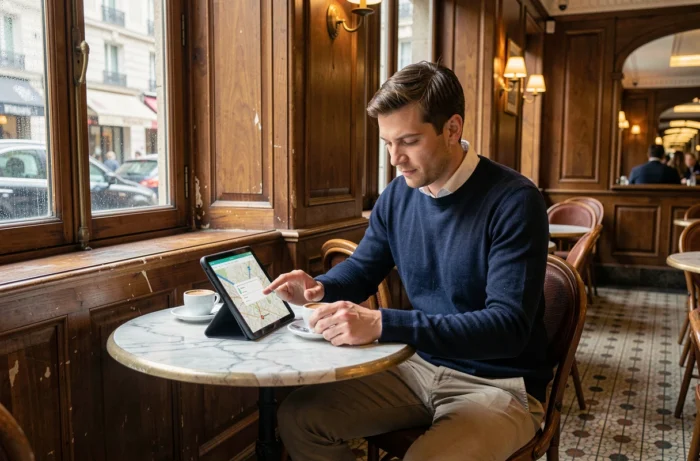
The City of Paris has deployed a multifactor authentication (MFA) on nomades.apps.paris.fr for certain profiles of agents considered sensitive: finance, civil status, human resources. A simple username/password combination is no longer sufficient for these accounts.
In practice, logging in requires a code sent via SMS or generated by an application like Microsoft Authenticator. The catch lies in the configuration of the phone number associated with the account.
- Ensure that the mobile number linked to the Intraparis account is up to date, especially after a change of line or device
- Install and test the authentication app before departure, not at the hotel on Monday morning
- Plan for a backup second factor (alternative number or recovery codes) if the mobile network is unstable in the chosen accommodation
The remote connection must be tested before the stay. A complete test from an external network (home Wi-Fi, tethering) allows for detecting an MFA block, an expired password, or an outdated phone number. Waiting until the first day of telework to discover the problem amounts to losing half a day in exchanges with support.
Complementary Apps for a Productive Stay in Paris
The remote portal covers HR management and messaging, but it does not replace field tools. During a Parisian stay combining remote work and travel, several applications are worth installing in parallel.
Navigation and Transport in Paris
Local transport applications (Île-de-France Mobilités, Citymapper) calculate multimodal routes integrating metro, bus, tram, and bike-sharing. Citymapper remains the reference for real-time information on line disruptions, which is crucial when a professional appointment depends on a connection.
For pedestrian navigation, offline maps avoid reliance on the mobile network in areas with weak coverage (basements, certain covered passages). Downloading the offline map of Paris before departure takes a few minutes and eliminates a recurring friction point.
Cultural Guides and Digital Mediation
Paris has digital mediation applications for its museums and heritage sites. The Louvre, Versailles, and several municipal museums offer embedded guides with audio content and thematic routes. These applications often work offline once the content is downloaded, making them usable even without data.
The Balades Paris Durable app, published by the City of Paris, offers urban walking routes focused on biodiversity and environmental heritage. For an agent on an extended stay, it provides an interesting complement to lunch breaks.
Network Security and Good Remote Connection Practices
Connecting to Intraparis from hotel Wi-Fi or a Parisian café exposes one to risks that the City of Paris’s IT charter explicitly mentions. Articles 323-1 to 323-7 of the penal code, referenced on the homepage of the remote portal, regulate unauthorized access attempts, but the agent’s responsibility also extends to securing their own workstation.
- Prefer mobile tethering (4G/5G) over unencrypted public Wi-Fi
- Ensure that the URL starts with nomades.apps.paris.fr before entering any credentials
- Never save the Intraparis password in a shared browser (hotel, coworking space)
- Activate automatic lock on the device after a few minutes of inactivity
We also recommend separating the browser used for Intraparis from the one dedicated to personal browsing. A separate browser profile (or systematic private mode) limits the risks of session leakage.
Session Expiration and Logout
The remote portal applies automatic logout after a period of inactivity. Regularly saving your work prevents losing an HR form in progress. This short session behavior is intentional: it reduces the exposure window in case the device is left unattended.
An agent’s Parisian stay connected relies less on the number of installed applications than on the technical preparation in advance. Authorized access, tested MFA, updated phone number: these three checks are sufficient to avoid most of the blocks encountered on the ground.