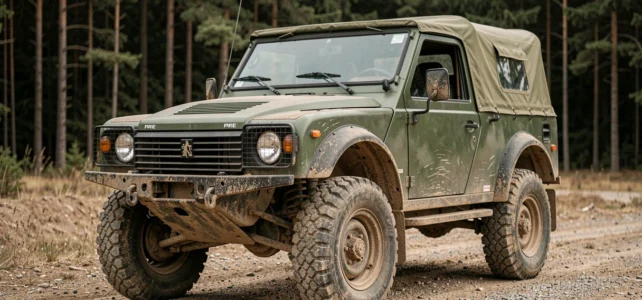
The Peugeot P4, derived from the Mercedes-Benz G-Class and produced for the French army, is a robust off-road vehicle designed with military specifications in mind. Its diesel engine, manual transmission, and rigid axles provide a solid foundation, but performance remains modest for civilian use. Several mechanical modifications can enhance torque, reliability, and driving pleasure, provided certain regulatory constraints, often overlooked, are respected.
Classic registration and modifications on a Peugeot P4: what you need to know before touching the engine
Before disassembling anything, one question arises: is your P4 registered as a classic vehicle? If so, the rules change radically.
The designation “classic vehicle” is granted only if the original technical specifications have not been modified: engine, chassis, braking, steering. An engine swap, a conversion from drum to disc brakes, or an extensive reprogramming are considered prohibited modifications in FFVE homologation files.
In practical terms, an owner wishing to improve the performance of a Peugeot P4 must choose between two paths. Either maintain the classic status (with its advantages for technical inspections and taxation) and limit themselves to reversible improvements. Or switch to a standard registration, accept the standard technical inspection, and open the door to heavy modifications.
This choice conditions all subsequent technical decisions. Specialized P4 forums rarely address this point, even though it should be the first reflex before any mechanical investment.
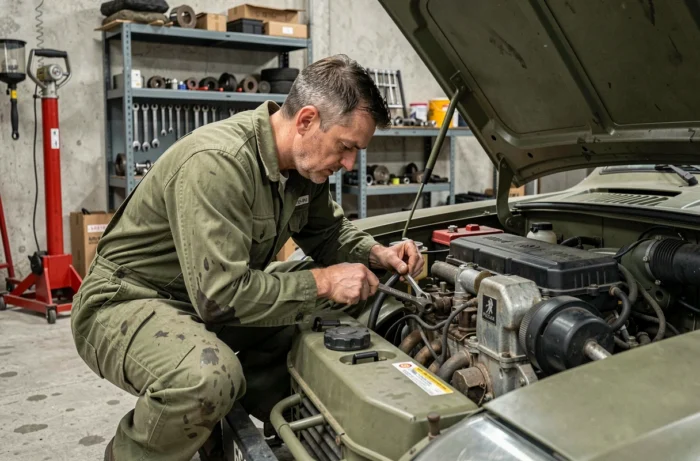
Diesel engine optimization P4: gaining torque without replacing everything
The XD3 diesel engine that powers most of the decommissioned P4s is known for its reliability but is underpowered. Its modest power makes overtaking difficult and load climbs laborious. Have you noticed that endless response time when accelerating? This is a trait shared by almost all original P4s.
Engine reprogramming and injection
On the mechanical injection diesel versions, the margin for maneuver comes from the adjustment of the injection pump. A specialist can adjust the flow and timing to recover torque at low revs, where the P4 needs it most off-road.
For the rare versions equipped with electronic injection (or after a swap to a newer engine), a “stage 1” engine reprogramming affects the injection mapping and the turbo. This type of intervention aims to increase torque without replacing mechanical parts, staying within the engine’s tolerances.
Air intake and exhaust
Two simple modifications improve the engine’s breathing:
- Replace the original air filter with a washable high-flow filter. The power gain remains marginal, but the response to acceleration improves, and maintenance is simplified in the long term.
- Install a less restrictive exhaust system, with a slightly larger diameter. On a naturally aspirated diesel, reducing back pressure allows the engine to expel burnt gases more effectively.
- Check and clean the exhaust gas recirculation (EGR if present) circuit or clogged intake ducts. On a military vehicle stored for a long time, clogging is often the primary cause of power loss.
Transmission and running gear: ensuring reliability before toughening up
The P4 shares its transmission with the Mercedes G-Class, which facilitates parts supply. The transfer case, front and rear axles, and drive shafts are sized for intensive use, but decommissioned examples often have accumulated thousands of kilometers on track without regular maintenance.
Why start with the transmission rather than the engine? Because a torque gain is useless if the drive shafts are worn out or if the axle oil hasn’t been changed since the vehicle was decommissioned.
Priority inspection points
- Drain the gearbox, transfer case, and both axles with oils meeting original specifications. This operation alone can transform the vehicle’s behavior.
- Inspect the drive shaft universal joints and transmission boots. Excessive play causes vibrations and accelerates wear on other components.
- Check the front and rear hub bearings. Bearing references for the front axle are available through specialized military vehicle suppliers.
- Inspect the spring leaf and axle mounting bushings. On a vehicle over thirty years old, worn bushings absorb part of the engine torque before it reaches the wheels.

Tires and geometry: the most underestimated performance lever
The choice of tires transforms the behavior of a P4 much more than an engine reprogramming. The original military tires prioritize puncture resistance and traction on loose terrain, but their performance on the road is mediocre.
Switching to a mixed road/off-road tire of compatible size reduces rolling resistance. The engine works less to maintain a given speed, resulting in lower fuel consumption and a more comfortable cruising speed.
The geometry also deserves a thorough check. Poorly adjusted alignment on a vehicle with rigid axles generates constant lateral drag. On a P4 with limited power, every unnecessary loss is felt directly.
Electricity and cooling: two chronic weaknesses of the P4
The original electrical system is designed for 24 volts for military use. The conversion to 12 volts, common after decommissioning, requires an appropriate alternator and revised wiring. A sloppy installation causes voltage drops that disrupt diesel preheating and battery charging.
A faulty preheating system degrades cold starts and increases engine wear. Checking the condition of the glow plugs and the timed relay is a low-cost intervention that significantly improves daily driving pleasure.
The cooling system, designed to operate under extreme conditions, deteriorates when the vehicle remains stationary. Replacing the thermostat, bleeding the system, and checking the radiator before any sustained outing prevents overheating that can damage the cylinder head.
The most effective modifications on a Peugeot P4 are not always the most spectacular. A well-maintained transmission, suitable tires, and a reliable electrical system transform the driving experience more than a few extra horsepower obtained at the cost of compromised homologation.